Thursday, April 22, 2010

Social Networking

Religious network: MyChurch (www.mychurch.org)

Advantages: Churches all around the world can sign up and share their faith with all other Christians around the globe. Users can share sermons, blog about the religion and learn more about the Church through connecting with other Christians. Non-Christians can also join and learn more.

Disadvantages: The pricing for the full-plan membership of a church are quite hefty ($199/month), and even the most rudimentary and basic plan is at $9 a month. Christians cannot register individually, rather through their church, which has to pay.

Political network: Redblueamerica (www.redblueamerica.com)

Advantages: Americans all over America can share their views on American politics on this website. This social network is open to Democrats as well as Republicans to discuss and debate the politics of the US, and all users get their own blog, where they can express themselves, and the home page contains topics of discussion and recent blogs. Membership to this network is free.

Disadvantages: This social network is only useful to Americans, and those interested in American politics. All the rest of the people who do not follow American politics closely do not have any point in using this network.

Educational network: The Schools United (www.theschoolsunited.com)

Advantages: This social network is dedicated to the worldwide education community. It provides staff a platform to share and discuss resources and experience. It is a great place for teachers to get teaching aids, share field trip ideas, get artistic tools and many more. All schools can make a profile page/blog highlighting their school, and sharing their interests. This social network is absolutely free.

Disadvantages: Teachers or any ordinary people cannot join the website individually, but have to do so through a school. This makes it hard for retired or home-schooling teachers to access the network, and share their ideas. Also, it is only for teachers. An educational community consists of teachers, students and parents, but only teachers have a platform to interact.

Wednesday, April 21, 2010

Reflection - 'What Causes Earthquakes'

I believe this task was meant to show us how different types of literacies can be used to explain technical concepts, and how they make it much more logical and simple in comparison to plain text. I opted for pictures to explain the causes of earthquakes, and found that the pictures really helped convey quite a difficult/technical concept in a comparatively simple way.
I found this task slightly challenging, as the concept was a bit hard to grasp at first, but after going through a few websites it became clearer, and I looked for the best way to explain it in an easier way. I divided it into 4 steps, describing a bit about the layers of the Earth, plate tectonics, the collision of the plates, and finally, how that causes earthquakes to happen.
I found some images that brought out these steps quite well, included them, and cited the sources in the end.

What Causes Earthquakes

Earthquakes are one of the major natural disasters that occur in the world. They kill and injure millions of people around the world yearly, and cause damages worth millions of Dollars. It is essential to know what causes them, and the science behind them.


An earthquake is, essentially, a release of elastic energy from two colliding tectonic plates. This energy causes intense shaking of the Earth’s crust on which we live.


The Earth is divided into the following layers:

Crust

Mantle

Outer Core

Inner Core


The Crust of the Earth is divided into many pieces called ‘tectonic plates’. These plates float on the mantle, and are constantly moving about due to the currents in the mantle. These are called ‘convectional currents’.


When two plates collide with each other, they are not smooth. They create a lot of friction, which then makes a lot of tension under the

Earth’s crust.


As the tension mounts and mounts, the plates eventually snap apart, and the tension is released in the form of elastic strain ‘seismic waves’, which move upward through the crust and split the rock at the surface, creating earthquakes as well as fault lines.


Earthquakes can also cause volcanoes to be formed, and erupt, as the sliding tectonic plates make room for the magma in the mantle under the plates to be released as lava from volcanoes. Landslides can occur when

earthquakes happen in rocky areas.When earthquakes occur under the sea, the water is displaced, and tsunamis occur. Tsunamis are like giant tidal waves which strike the shores of an ocean after an earthquake.


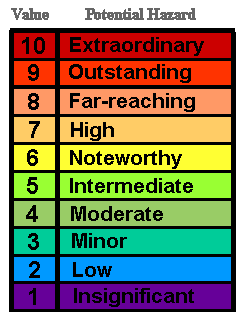
Earthquakes are measured in the ‘moment magnitude’. This is similar

to the previously used “Richter scale”. The moment magnitude is what seismologists (people who study earthquakes) use to measure the intensity of an earthquake. An earthquake of scale 1-3 can hardly be felt as a weak tremor, but an earthquake of about 7-8 magnitude would be enough to cause tremendous damage and wreck houses. The intensity of the earthquake grows exponentially with every number increasing, as the intensity increases 1000% with every increasing number.


Bibliography:

http://en.wikipedia.org/wiki/Earthquake

http://www.buzzle.com/articles/what-causes-earthquake.html

http://www.soest.hawaii.edu/GG/ASK/earthquakes.html

Images:

http://www.dkimages.com/discover/previews/1000/50244966.JPG

http://faculty.kutztown.edu/friehauf/plate-tectonics.jpg

http://library.thinkquest.org/10136/media/layers2.jpg

http://www.empr.gov.bc.ca/Mining/Geoscience/SurficialGeologyandHazards/Earthquakes/PublishingImages/eq-2b.gif


Sunday, April 11, 2010

Reflection on 26.3.10 lesson

In this lesson, I learnt a lot about Web 2.0 and Computer Networks.
I learnt that Web 2.0 technology is used in most of the common software we use everyday, including this website Blogger.
I also learnt about how computers can be connected via LAN or WAN. I learnt the different types of connections that can be used to work a LAN, which include: bus, ring and star.
I did the quiz before and after going through the information and taking notes, and got them all right after I had done this, showing me that I had understood it well.

Friday, March 26, 2010

Web 2.0


Web 2.0 is a term used to refer to websites that essentially allow interactive facilities on the web, rather than just plain viewing of text and graphics. The advantages of Web 2.0 include:
  • It is simple. Easy for anyone to publish on the Internet.
  • It makes the web social. Allows people to connect with each other easily.
  • It is open. It allows websites to exchange information with each other.
It is generally about interactive and user-generated material on the Web. It builds upon the technologies of the original web and makes it richer.

Examples of websites that run on Web 2.0 platforms are:
  • Facebook
  • YouTube
  • Twitter
  • Google Buzz
  • Gmail
Acknowledgements
http://www.go2web20.net
http://oreilly.com/web2/archive/what-is-web-20.html
http://www.paulgraham.com/web20.html
http://simple.wikipedia.org/wiki/Web_2.0